
Universities often work at the edge of emerging nuclear technology. They partner with reactor developers, fuel companies, national laboratories, federal agencies, and international researchers. Those relationships can create enormous value. They can also create export-control questions that are easy to miss.
One of the most important concepts in this area is the Fundamental Research Exclusion, often called the FRE.
In simple terms, the FRE can allow certain university research results to remain outside normal export-control restrictions when the work is intended for open publication and broad scientific sharing.
That sounds reassuring. The problem is that many projects are more complicated than that.
A university may think of a project as academic research while a sponsor thinks of it as proprietary development. A professor may expect to publish freely while the research agreement gives the sponsor meaningful control over what can be released. A project may begin as open research and later incorporate technical information that came from an industry partner.
At that point, the phrase “this is university research” no longer answers the compliance question.
Why the FRE matters
Export-control rules can restrict the transfer of certain technical information to foreign persons. In a university setting, that can affect ordinary activities such as:
- discussing technical work with foreign-national researchers;
- sharing project files with international collaborators;
- allowing access to certain laboratories or systems;
- sending technical information overseas;
- working with a foreign university or company; or
- involving international students in sponsored research.
When the FRE properly applies, many of these concerns can become much easier to manage because the research results are intended to enter the public scientific community.
When it does not apply, the university may need to understand what information is controlled, which people may receive it, and whether authorization or additional safeguards are required.
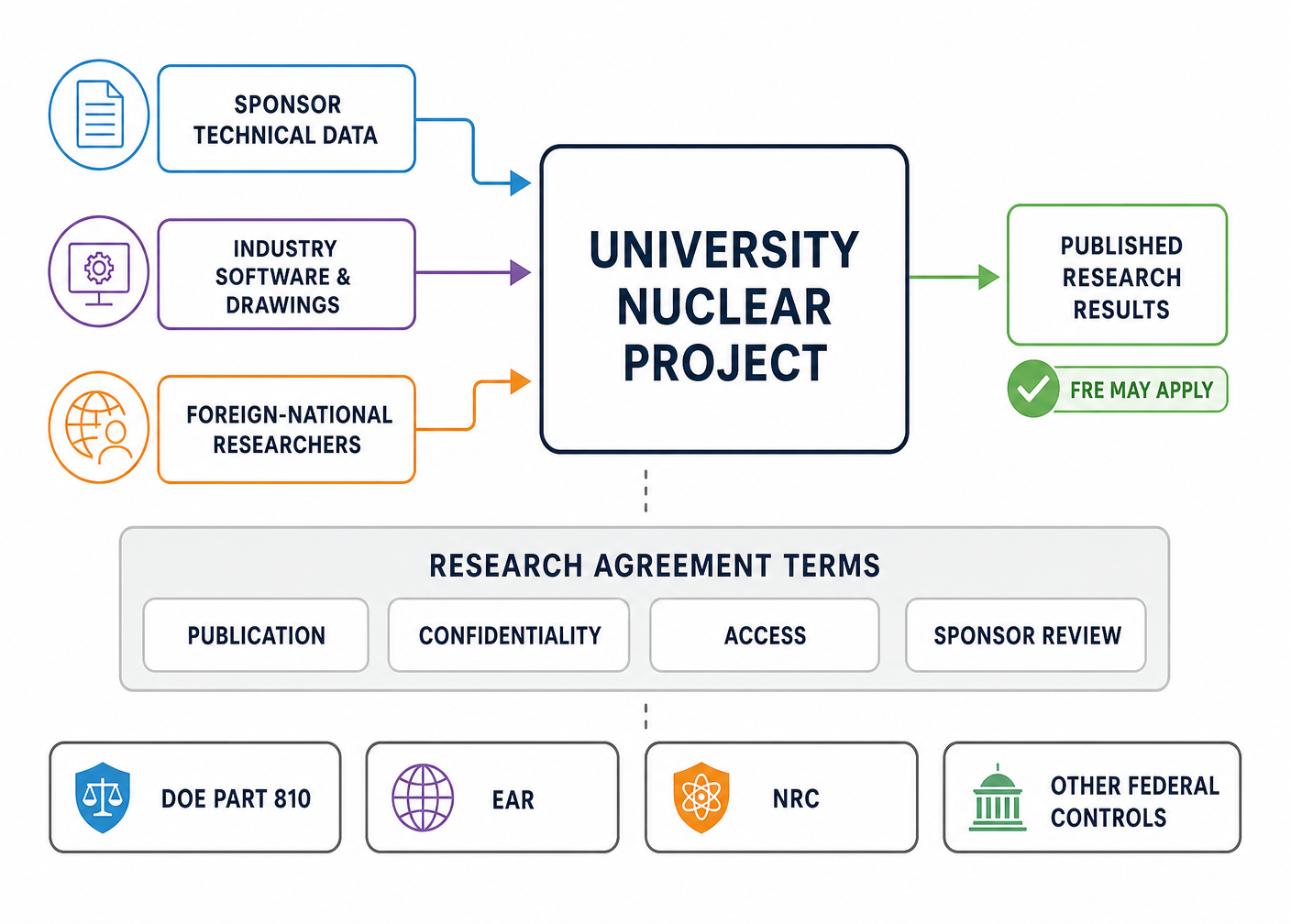
For nuclear research, this can become especially important because several regulatory regimes may be relevant. Depending on the activity, a university may need to consider the Department of Energy's Part 810 requirements, the Export Administration Regulations, Nuclear Regulatory Commission requirements, and other federal controls.
The contract can change the answer
For many university projects, one of the most important export-control documents is not a regulation. It is the research agreement.
Sponsored-research agreements often contain provisions covering publication, confidentiality, intellectual property, access to information, foreign-national participation, and sponsor review.
Those provisions matter because fundamental research depends heavily on the expectation that research results will be openly published and shared.
For example, a sponsor may reasonably want time to review a draft paper before publication so it can identify its own confidential information or protect patent rights. That type of review does not necessarily create a problem.
A different situation arises when a sponsor can decide whether research results may be published at all, significantly delay publication, restrict who can participate, or prevent certain findings from being disclosed.
Those terms deserve export-control attention before anyone assumes the FRE applies.
This is one reason research security, export compliance, sponsored programs, legal counsel, and principal investigators should communicate early. A clause that looks routine to one group may have a very different meaning to another.
The FRE does not cover everything in the project
Another common misunderstanding is that if the research qualifies as fundamental research, everything connected with the project is automatically protected. That is too broad.
The research results may receive favorable treatment while other information used to conduct the research remains controlled.
Imagine that a nuclear technology company sponsors research at a university. The eventual academic findings may be intended for publication. The company, however, may provide proprietary design information, software, calculations, drawings, operating data, or other technical material so the researchers can perform the work.
That incoming information may have its own export-control status.
The same issue can arise with equipment, software, technical databases, international shipments, cloud systems, overseas travel, and collaboration with foreign institutions.
This is why FRE analysis should usually look at the entire flow of information surrounding a project rather than simply asking whether a professor plans to publish a paper.
Nuclear research deserves particular attention
Nuclear projects can be especially difficult because technology often moves between academic research, commercial development, government programs, and international partnerships.
A university may be studying reactor physics, fuel behavior, molten salt chemistry, advanced manufacturing, digital instrumentation, materials performance, or another subject that has both academic and commercial significance.
The university may also be working with foreign-national students and researchers, which is entirely normal in higher education.
The compliance question is whether the information they are receiving or developing can be shared with those individuals under the applicable rules.
That answer depends on more than the subject of the research. It can depend on where the information came from, what the sponsor has required, what will be published, what technology is involved, who will receive access, and which federal agency has jurisdiction.
The best time to ask is early
The most useful export-control conversations often happen before there is a problem.
If a university is negotiating a sponsored-research agreement, establishing an international collaboration, developing a new nuclear research program, or bringing industry technology into an academic environment, that is a good time to ask whether the FRE has been considered.
You do not need to become an expert in the Fundamental Research Exclusion. You do need to know when the question should be raised.
A few minutes of attention early in a project can reveal whether the issue is straightforward or whether the agreement, technology, participants, or information flows deserve a closer look.
That is where experienced export-control support can help: identifying the questions that need to be asked before contractual language and project decisions quietly determine the answer for you.